Understanding Equus: The Story Behind My First Book
Posted in :

When I started Horse Conversations in 2019, I was a student of horses.
I still am.
Learning to understand them has been one of the main threads running through my life since I first came into contact with horses as a child. Long before I studied equine ethology, long before I worked around hundreds of horses, long before I ever thought of writing a book, there was simply this pull toward them that I could never really explain.
I grew up on horse stories. I watched girls in breeches sitting on buses on their way to the stable, or cycling past with their helmets hanging from the handlebars, and I envied them more than I can say. Horses represented something bigger to me even then: freedom, belonging, something honest and alive.
But very early on, I also noticed something that never stopped bothering me.
There was a strange dissonance between how much we said we loved horses and how often we pressured, controlled and shaped them into whatever form we wanted them to take.
I remember noticing it especially during a pony holiday in the summer of 2006, shortly after we had moved back to my hometown. I was still a child, but something in me already registered the contradiction. The love for horses was real. The fascination was real. And yet so was the pressure to make them behave, perform, fit in and be useful.
That question stayed with me for years.
How can we say we love horses if we do not first try to understand them?
The grooming box I bought before I had a horse
My family and circumstances never really made a life with horses easy for me. There was no family horse, no childhood pony, no stable waiting for me after school.
So I found my own way into their world.
I worked at stables, cleaned manure, carried water buckets, wore handed-down breeches and used whatever old equipment I could get. I took the long route in, from the edges.
At one point, I secretly bought an entire grooming set and box with my pocket money, even though there was not one single horse in my life at the time.
No horse to groom. No stable to call home. No guarantee that any of this would ever become part of my real life. Just longing.
I still have that grooming box today, with a big fat “Sol” written on it.
To anyone else, it is just a plastic box full of brushes. To me, it is proof of how long this thread has been running through my life. Before I had access, before I had knowledge, before I had any professional identity around horses, I had the desire to be close to them and understand their world.
That box somehow survived all the versions of me that came after.
Horses stayed when everything else changed
My life has been turbulent in many ways. I have moved a lot, changed direction many times, reinvented myself, tried to find a place in careers and studies that looked more acceptable or sensible from the outside.
But horses stayed.
In 2019, after several failed attempts at studying something “proper,” as my mother might have called it, including design and psychology, I started studying equine ethology while working with horses in the Netherlands.
By then, I had already spent years reading, observing and trying to make sense of horse behavior on my own. The formal study gave me a deeper scientific foundation, but I was also carrying another kind of knowledge with me: years of practical experience, work in stables, contact with hundreds of different horses, and the perspective of someone who had always been highly sensitive to small changes in behavior, expression and atmosphere.
I needed to bring those two worlds together.
The science and the lived experience. The theoretical knowledge and the practical reality. The body, the nervous system, the environment, the learning history, the relationship.
And I needed to write it down.
That is how Understanding Equus began.
Why understanding horse behavior has to come before training
The horse world often starts with behavior and immediately jumps to intervention.
A horse refuses to go forward. A horse pins their ears. A horse becomes difficult to catch, anxious, pushy, shut down, distracted or resistant. And the first question is often: how do I stop this?
But horse behavior does not exist in isolation.
Every behavior happens inside a body. It is shaped by the nervous system, previous learning, physical comfort or discomfort, emotional state, environment, sensory input and the individual history of that horse.
That is why I believe ethical horse training begins before training.
It begins with asking better questions.
What is actually happening for this horse? What has this horse learned? Could pain or physical discomfort be involved? Does the environment support the needs of the species? What am I interpreting through a human lens that may make perfect sense from the horse’s point of view?
Equine ethology gives us a framework for looking at horses as horses rather than only through human expectation. Learning theory helps us understand how behavior changes. Anatomy, physiology and the nervous system help us see why behavior can never be separated from the body. Observation helps us notice what does not fit.
And empathy gives us a reason to care enough to keep asking.
Horse Conversations grew from the same question
Horse Conversations has had its own journey since 2019.
Some people know my work through courses, programs and the educational platform. Others have followed me for years on Instagram, where I have talked almost obsessively about horse behavior, welfare, training, communication and the horse-human relationship.
Because I really cannot stop.
The deeper I went into equine behavior, the more one thing became clear to me: horses deserve much more understanding from the world we have created around them.
And because that world is shaped by us, it is our responsibility to change it.
Not through another fashionable training method. Not through another guru. Not through another tool that promises to solve every problem.
Through better understanding.
What Understanding Equus is really about
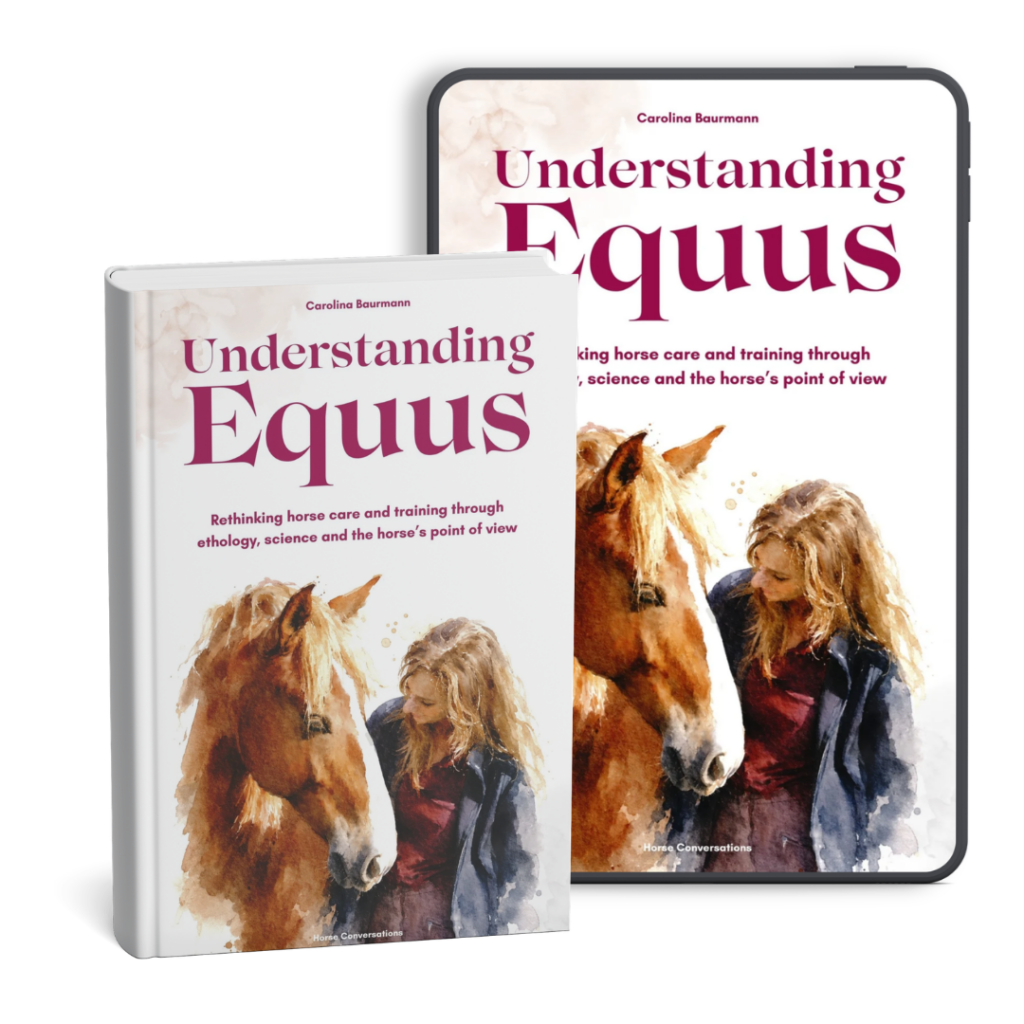
Understanding Equus: Rethinking Horse Care and Training Through Ethology, Science and the Horse’s Point of View is my attempt to bring that foundation together in one place.
The book moves from the inside of the horse outward. It begins with anatomy and physiology, including the skeleton, hooves, muscular system, digestive system and nervous system. From there, it moves into senses, emotions, psychology, learning theory, communication, body language and pain signals.
Only then do we arrive at housing, enrichment and training.
That order is intentional.
I do not think we should begin with what we want a horse to do. I think we should begin with what a horse is.
The book contains more than 34,000 words and over 50 illustrations. It brings together equine ethology, behavioral science, learning theory, practical experience and the questions I have been carrying with me for years.
It is not a step-by-step training method. It is a foundation from which to think.
A kinder horse world starts with better questions
I do not believe knowledge makes us perfect horse people. If anything, the more deeply you study horses, the more aware you become of how much there still is to learn.
But knowledge changes the quality of our decisions.
If I mistake pain for disobedience, my training decision changes. If I mistake fear for disrespect, my training decision changes. If I misunderstand reinforcement, my training decision changes. If I ignore the effect of housing, social contact or movement, my training decision changes.
Understanding gives us the chance to be more accurate, more careful and more humble. And that matters because horses do not choose the systems we build around them.
We do.
We shape where they live, how they move, how they eat, who they live with, how they are trained, what they are expected to tolerate and what behaviors we decide are acceptable. That responsibility is enormous.
But I do not want that thought to feel heavy. I want it to feel hopeful.
Because there is so much we can do once we begin looking more closely.
My first book is here
I have never done this before. I have never published a book. So this is a strange and important moment for me.
The little girl with the grooming box had no idea where any of this would lead. She just knew horses mattered to her. Years later, that same question has become a book.
Understanding Equus is now available as a Kindle eBook on Amazon.
For now, it is an eBook. But I want this work to grow. I want these ideas to reach more horse people, so that more horses can benefit from a shift away from control, assumption and inherited tradition, and toward observation, knowledge, empathy and understanding.
If you have followed Horse Conversations for a while, you probably already know pieces of this book.
If you are new here, this is probably the clearest place to begin.
And if you have ever felt that the horse world talks endlessly about training while not spending nearly enough time asking who the horse actually is, then I wrote this book for you.
Stop managing horses as objects. Start understanding them as the animals they actually are.
[Discover Understanding Horses on Amazon]
(choose your countries amazon (.de/.nl/.fr/.it) and search “Understanding Equus” in case you are not redirected automatically)