Softness in Horse Training is a result, not a cue
Posted in :

Lessons from Embodied Horsewomanship
#9 Softness is a result, not a cue
In (embodied) horse(wo)manship, we are usually working toward the same underlying goal, whether we consciously name it or not. We want horses that feel relaxed, safe, and predictable, and at the same time we want to experience safety and connection ourselves when we are with them. Beneath the surface of countless methods, techniques, schools, and philosophies, I believe this shared longing is what unites most people who dedicate their lives to horses, even if the language and tools they use look entirely different.
Where things begin to diverge, sometimes dramatically, is not in the destination but in the way we try to get there.
In recent years, more and more approaches promote themselves through ideas like softness, contact, bend, or connection, yet they treat these qualities as cues rather than outcomes. Softness becomes something to ask for, to train, to install, or to demand within a session, rather than something that is allowed to emerge. In these frameworks, relaxation is no longer the natural end point of regulation and trust, but a required performance that the horse is expected to deliver, often from the very beginning.
This is where the problem starts.
When softness becomes a technique
When softness becomes a technique, it stops being softness. Horses may be guided, pressured, positioned, or subtly coerced into postures that look relaxed on the outside, while internally their nervous systems are still managing arousal, discomfort, or the avoidance of escalation. This can happen through rein pressure with a bit, through leverage in rope halters, or through body manipulation using flags, sticks, or spatial pressure, often explained as communication or nervous system work and usually carried out with good intentions. Yet intention alone does not change the underlying mechanism at play.
Softness is never created mechanically. It does not originate in posture, nor can it be installed through tools, timing, or correct technique. Softness is a state of the nervous system, and the body merely reflects what is already happening internally.
A horse becomes soft when the conditions are right, much like a plant grows when the soil has been prepared properly. You cannot force a seedling to grow by pulling on it, and you cannot create genuine relaxation by shaping the body from the outside in. You prepare the ground, regulate the environment, and allow the organism to respond when it feels safe enough to do so.
Softness lives in the nervous system, not the posture
This distinction matters, because a lowered head, a rounded neck, or slower movement does not automatically mean relaxation. These responses can just as easily be learned strategies to avoid pressure or discomfort. All animals with a nervous system are wired to seek the parasympathetic state, the state that supports balance, digestion, healing, learning, and integration. When pressure is applied in a predictable way, a horse will often comply in order to avoid further arousal, but avoidance is not the same as choice, and compliance is not the same as safety.
Sustainable relaxation has to be chosen by the nervous system, not negotiated through pressure. When we focus exclusively on posture changes or external signals, we are working with symptoms rather than causes. We may succeed in shaping what the horse looks like, but we miss what the horse is actually experiencing.
True softness emerges from regulation that works from the inside out. When the nervous system settles, the body follows naturally. This kind of softness is not something we need to manufacture or cue, but a byproduct of alignment within the system. And this is where embodied horsewomanship asks something more demanding of us, because it cannot be outsourced to equipment or technique.
The primary tool in this work is not something we hold in our hands. It is our own nervous system.
You are the primary cue
We already transmit information constantly, whether we are aware of it or not, through our body posture, muscle tone, the quality and rhythm of our movement, our breathing patterns, facial expression, emotional state, and even the thoughts that shape our internal chemistry and heart and brain rhythms. Horses perceive this long before they register any explicit cue, and they respond to it with remarkable precision.
This is where the real learning happens. Not in what we do, but in who we are being while we do it.
Horses do not learn softness because we ask for it correctly. They mirror regulation when it is present. We cannot guide them into a state that we are unwilling or unable to access ourselves. Softness is not something we cue; it is something we embody, and the nervous systems in our space respond accordingly.
Before asking your horse to perform anything, it is worth pausing to ask a much more fundamental question: what kind of space am I creating right now? Not what exercise you are about to do, not what outcome you want, but the quality of the field you are inviting your horse into. When that changes, everything else tends to simplify. You need fewer cues, fewer techniques, less equipment, and far less force disguised as communication.
Softness stops being something you chase and becomes something that happens.
This is not about doing less with your horse, nor about lowering standards or avoiding clarity. It is about becoming more available as a nervous system and more honest about the influence we already have. That is a skill in itself, one that can be learned, practiced, and embodied over time.
Softness is not a cue. It is the natural consequence of who you are being when you share space with a horse.
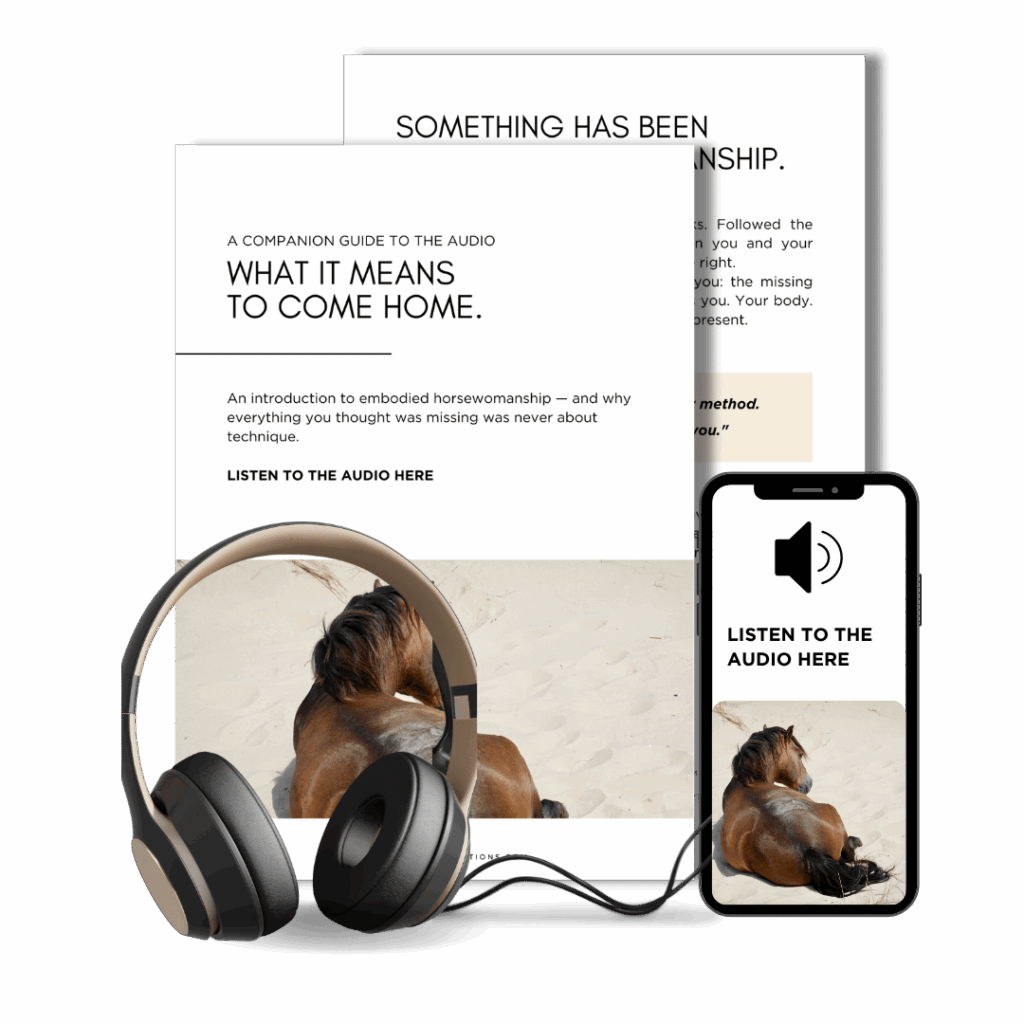
Tip your toe into my nervous system work for horsewomen
Come home to your body, come home to your horse
A guided body scan for horsewomen who feel something is off – but can’t quite name it yet. Press play, breathe, and let your horse feel the difference.
WHAT YOU’LL GET ↓
- A 12-minute guided body scan you can do at the stable fence, in the field, or anywhere before you’re with your horse.
- A different way of arriving – not with a plan, a technique, or a method. With your body. With presence. With enough.
- The beginning of a new conversation with your horse – one that starts in your nervous system, not in your head.
Subscribe for free to get your download ↓